


Erik went to China expecting to be bored.
He’d been warning his daughters for weeks. Schlepping around Chinese cities in the middle of summer, hot and terrible, nothing to do. He booked hotels with pools so there would be something to do. He’d spent 2005 to 2008 going in and out of the country for a hedge fund and had come away thinking China was great for business, culturally commercial, transactional. Fine to work in. But there was no reason to linger.
For your capital markets training needs, visit my friends at Finance Talking.

He discusses how a robot delivered them ibuprofen to their hotel room in less than half an hour for $2.
“How did anybody make any money in this transaction?” he asked me. Someone manufactured it, a store stocked it, a man on a scooter carried it across Beijing, a robot rode the lift. Two bucks.
A throwaway overnight stop at Jingdezhen turned out to be the real deal. A great high-end consumer experience: a meal for four with beers for £45, domestic clientele and somewhere almost nobody had heard of. He loved it.
In Shanghai, a rooftop bar, the buildings lit with a sense of pride, a techno party, and a few hundred kids dancing their brains out with the CCP flag flying on the pole above them. The following night, a shopping mall converted into four floors of clubs, a seventeen-year-old girl laying down her own tracks to a mainly domestic crowd, everyone in outrageous outfits, none of it derivative.
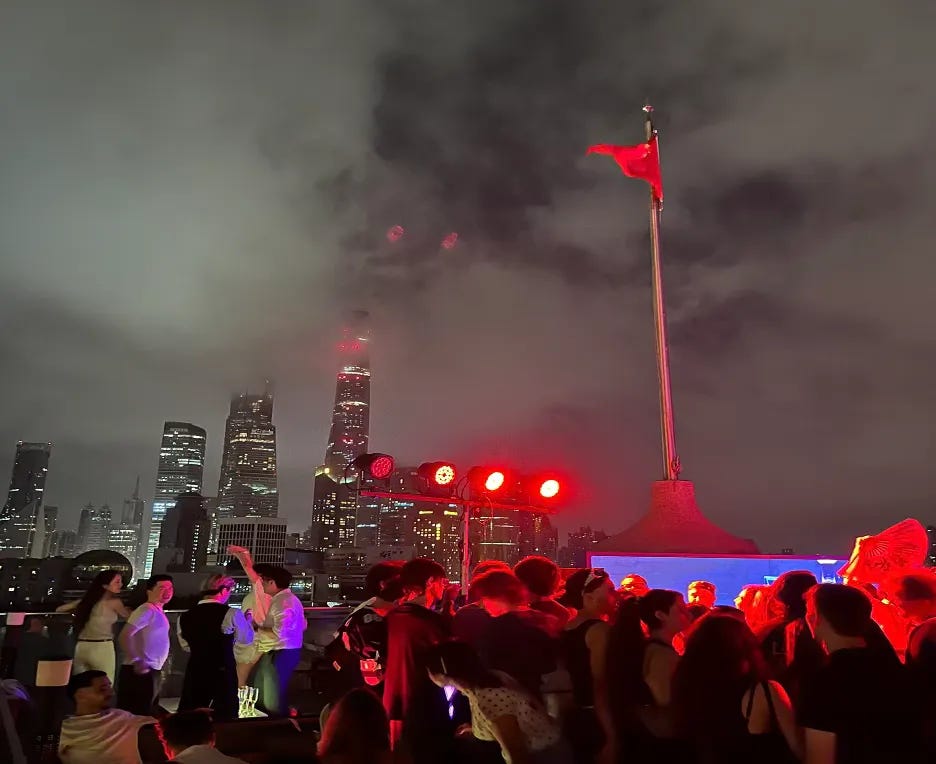
“How is this possibly the second world?” he said. Newer buildings, better infrastructure, extraordinary airports. Clean, calm, safe, cheap.
From his professional angle, Erik’s global factor model has been flagging China as one of several interesting countries by estimates revisions. The data had been pointing his attention east for a while. This family trip was the qualitative confirmation, delivered by two teenagers with none of his baggage who just thought the place was cool.
He is not naive about it. The face scanning is constant, to the point where he stopped registering it. In his view, the real ceiling isn’t China’s capability, it’s trust. Nobody wants to own a bond adjudicated in a Beijing court. If China could bend the knee slightly and behave a little more like Singapore or Korea, he says, it would go supersonic. That it can’t is the brake.
The second half of our conversation was about a chart book.
The University of Michigan survey asks ordinary people what they think prices will do next year. From 1980 to 2020, the answer was 3 to 4%. Every year. Four decades of the same number. It is now 8 per cent, and has been above 6 for five years. The Fed’s dot plot, meanwhile, has inflation drifting down to about 2.3%.
Erik’s point isn’t just the size of the gap; it’s the direction of causation. Line the survey up against the bond market back to 1978, and the consumer moves first, by roughly two years, consistently. Read that chart as a Martian, and you’d conclude the 10-year is on its way to five or six%.
Expectations are self-fulfilling. When everyone assumes prices are stable, a company that raises by thirty per cent gets punished, so firms police each other. Once resistance goes, so does the policing. The pub burger was £8 or £9, then £12, now £15. So why £25?
His read is that Warsh sees the problem and can’t do anything about it. Consumer sentiment is currently below where it was in 2008, with the market at highs, unemployment at 4% and nominal growth running 5 to 6%. You do not make a miserable electorate feel worse three months before the midterms.
Project Zimbabwe, S&P 10,000 & Cheap Energy with Erik@YWR

Before we dive into the first episode of 2026
Which leads directly to Project Zimbabwe with nominal inflation accelerating, a Fed not policing it, and nominal earnings exploding, 25% EPS growth this year, 17% next, against a long-run average near 7. As he has told us before, we crash upwards.
Which brings us to the trade he likes least emotionally and most analytically.
If I’d told you in January that the Middle East would be at war and the Strait of Hormuz effectively closed for six months, you would not have guessed Brent below $90. The dream scenario arrived, and the asset couldn’t hold a 100. That looks like structural oversupply.
Erik reads it differently. The levers that absorbed the shock were short-term by design: the SPR drawdown, China cutting three million barrels a day of demand, the Saudi bypass pipeline that is now itself being hit. And the Houthis joining in has turned it into an uncontrollable bench-clearing brawl. What if this is a multi-chapter story?
The critical question is: what is the supply response? And his answer is the best argument in the episode. Imagine you’re the executive with a plot of land in Louisiana and refining margins at record highs. The refinery costs two billion dollars and takes seven years. You have to walk into a board meeting and argue that the margin survives a peace deal. Almost nobody can underwrite a five-to-ten-year problem with confidence.
That hesitation is the opportunity. The difficulty of believing in the thesis is what keeps the margin alive long enough to make money from it. Re-architecting global energy supply away from the Gulf means more pipelines, more drilling in Brazil and Africa and the North Sea, and US LNG terminals suddenly able to sign contracts now that Qatar is unreliable. This, he thinks, could be a more valuable theme than AI. It is priced at levels of disbelief precisely because no one wants to bet on Mad Max, when they can dream about AI.
He says every data centre bottleneck has been mapped and traded: optics, memory, boards, turbines, HVAC. But nobody wants to own the thing those data centres will consume every single day for the next twenty years. Gas demand is arriving on three legs at once. Via Gulf LNG expansion, data centre power across Virginia and the southeast, and reshored manufacturing, with Arizona building a pipeline to the Permian to feed TSMC’s Phoenix fabs. US nat gas supply is the space he is working on. The sector has gone nowhere due to concerns that last time, the industry killed the golden goose with oversupply.
The thread running through all three stories is scarcity, and how we price it. Oil peaked near $150 in 2007 and hasn’t made a high since. Gold has more than trebled. The pub burger has at least doubled. Erik’s own caveat is the right one to end on. Everybody chases scarcity now, so the discipline is paying attention to what you’re actually paying, exactly why he’s looking in the corners nobody else wants.
If you enjoyed this and know anyone else who might also, then please share here:
Please consider subscribing:
And if you have any comments or thoughts to share, then you can now buy me a coffee and leave a message. It would be great to hear from you.
Thanks for listening.
Jeremy


